
Is Shopify Hydrogen Worth It in 2026? A CTO's Cost-of-Ownership Check
Shopify Hydrogen is worth it when your storefront has outgrown what a Liquid theme can do and you have engineers who will own it after launch. The hosting is free on Oxygen and the checkout stays on Shopify, so the real cost is not the build. It is the upgrade calendar: Hydrogen releases track Shopify's quarterly Storefront API versions, each API version is supported for at least 12 months, and in 2025 the framework underneath Hydrogen changed from Remix to React Router 7. If nobody on your side is budgeted to absorb that, a well-built Liquid theme is the better business decision.
Key takeaways (checked against shopify.dev and npm on September 28, 2026):
- The current stable release is Hydrogen 2026.4.5 (August 14, 2026). It pins Storefront API version 2026-04 and React Router 7.16. Hydrogen 2026.10 is in preview.
- Oxygen hosting is included at no additional cost on Starter, Basic, Grow, Advanced, Plus, and Pause and Build plans.
- Shopify ships a new API version every quarter and supports each one for a minimum of 12 months. Plan for at least one Hydrogen upgrade a year, realistically two, because Hydrogen releases have landed up to 4 months after their API version.
- Self-hosting on Vercel or Netlify is supported, but Shopify's own self-hosting guide warns it may not cover features introduced in 2025-05 and later.
- Our custom Hydrogen builds typically take 3 to 7 weeks and start from $3,400. The maintenance line item needs its own row in the budget.
What does Hydrogen cost to host?
Nothing extra, if you deploy to Oxygen. Shopify's Hydrogen and Oxygen fundamentals list Oxygen as included at no additional cost on every standard paid plan from Starter to Plus. Development stores, Plus sandbox stores, and trial plans can deploy too, but their deployment URLs sit behind a store login, so you cannot run a public preview from them.
Oxygen is Shopify's edge runtime, built on Cloudflare's open-source workerd. For a tech lead comparing this with a Next.js commerce front end on Vercel, the difference is a line item that does not exist: there is no bandwidth overage and no metered image optimization to forecast. Our hosting cost calculator shows how quickly image optimization alone adds up on metered platforms at real traffic levels.
The Storefront API also does not throttle shoppers. Shopify's API limits page states that buyer traffic on the Storefront API is not rate-limited; the limits that do apply target bots and checkout abuse. A flash sale does not need a rate-limit budget on the storefront side.
Where does the real cost of Hydrogen sit?
In the upgrade calendar. Hydrogen uses calendar versioning that mirrors the Storefront API: the package version 2026.4.x ships with the API version constant set to 2026-04. We checked this in the published npm package today, not in a blog post about it.
Shopify's versioning policy sets the pace for everything downstream:
| Shopify policy | What it means for a Hydrogen team |
|---|---|
| New API version every 3 months, on the first day of the quarter | 4 Hydrogen minor lines per year to evaluate |
| Each stable version supported for a minimum of 12 months | At least 1 forced upgrade per year, or the storefront falls onto an unsupported API |
| At least 9 months of overlap between consecutive versions | Upgrades can be scheduled, not emergencies, if someone owns the calendar |
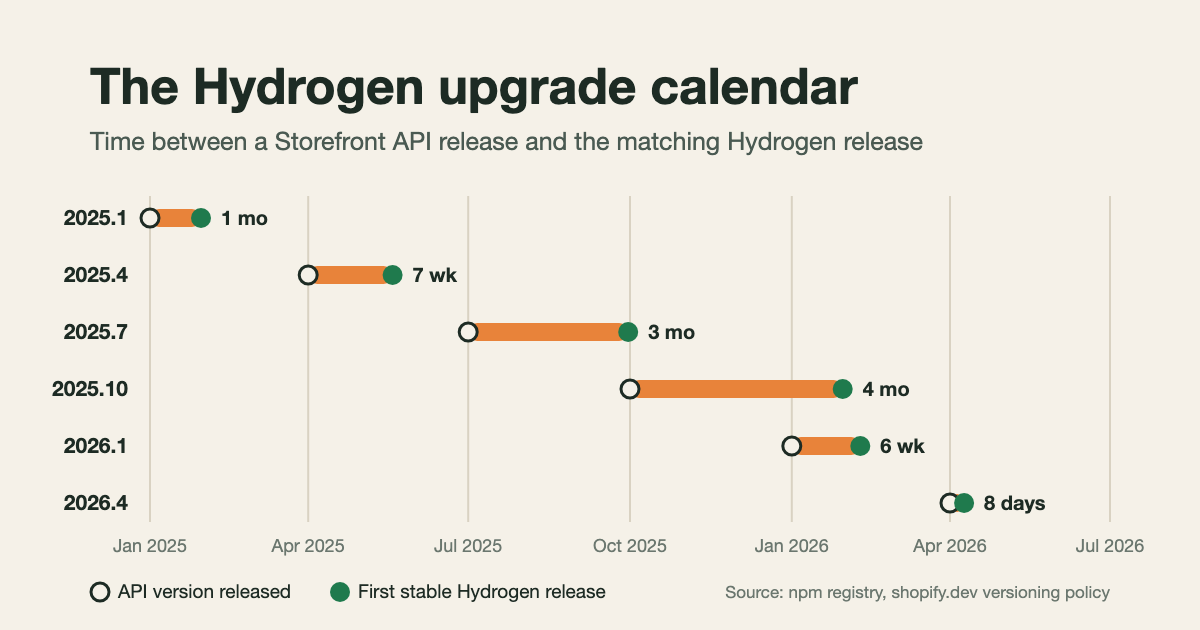
There is a detail the policy page does not spell out. The 12-month clock starts when Shopify releases the API version, not when the matching Hydrogen release lands, and Hydrogen does not always ship on day one. From the npm registry, first stable release of each line:
| Hydrogen line | API version released | First stable Hydrogen release | Lag |
|---|---|---|---|
| 2025.1 | January 1, 2025 | 2025.1.0, January 30, 2025 | about 1 month |
| 2025.4 | April 1, 2025 | 2025.4.0, May 19, 2025 | about 7 weeks |
| 2025.7 | July 1, 2025 | 2025.7.0, September 30, 2025 | 3 months |
| 2025.10 | October 1, 2025 | 2025.10.0, January 30, 2026 | 4 months |
| 2026.1 | January 1, 2026 | 2026.1.0, February 9, 2026 | about 6 weeks |
| 2026.4 | April 1, 2026 | 2026.4.0, April 9, 2026 | 8 days |
A team that adopted Hydrogen 2025.10 on release day got about eight months of guaranteed support, not twelve: the minimum window for API 2025-10 runs out on October 1, 2026. Shopify may keep a version alive longer, but the policy only promises the minimum.
The quarterly cadence is manageable. What catches teams out is a framework-level change arriving through the same channel. In Hydrogen 2025.5.0 (May 21, 2025), Shopify moved Hydrogen from Remix 2 to React Router 7. Every route file changed its imports, the dev scripts changed, and type generation moved to react-router typegen. A storefront that skipped two or three quarterly upgrades before that release faced a multi-quarter catch-up plus a framework migration at once.
Budget for it explicitly. A retained engineer or an agency retainer that includes framework upgrades is part of the price of Hydrogen, the same way a Liquid store's price includes app subscriptions.
When is Hydrogen the wrong call?
When the theme is not the ceiling. Sometimes our first-call answer is to stay on Liquid, and the reasons repeat:
- The catalog and content fit a theme. If a well-built Online Store 2.0 theme covers your design and your pages are already fast on real devices, Hydrogen adds engineering ownership without adding revenue.
- Your growth depends on theme-embedded apps. Many Shopify apps inject into Liquid themes. In a headless build each one needs a Storefront API integration or a headless replacement. Audit the app list before you scope anything.
- No one will own the repo after launch. A Hydrogen storefront is software. Without a named owner for the quarterly calendar above, it degrades.
Hydrogen earns its cost when a theme is the constraint: conversion-critical page speed you cannot reach in Liquid, storefront features no app provides, editorial content from a headless CMS living alongside commerce, or a design language the theme keeps diluting.
Does faster actually pay?
Yes, and the best-known evidence is older than most teams assume. The Deloitte study commissioned by Google, Milliseconds Make Millions (data from late 2019, published 2020), measured 37 European and American brand sites across more than 30 million sessions. For retail sites, a 0.1 second mobile speed improvement came with an 8.4% increase in conversions and 9.2% higher spend. It is a correlation study from 2020, not a guarantee for your store, but it is the original source behind most "every 100ms counts" claims.
The practical point for a Hydrogen decision: speed gains come from architecture you control. Hydrogen's caching sits at the sub-request level, and the documented defaults are worth knowing before you promise anyone a Lighthouse score:
// Hydrogen 2026.4.x, React Router 7.16
// Product data changes rarely: cache for 1 hour, serve stale for up to 23 more
const {product} = await storefront.query(PRODUCT_QUERY, {
  variables: {handle},
  cache: storefront.CacheLong(), // public, max-age=3600, stale-while-revalidate=82800
});
Shopify's own 95-second walkthrough of sub-request caching and stale-while-revalidate (ShopifyDevs, July 2023). Hydrogen has moved from Remix to React Router since then; the caching model shown here is unchanged in 2026.4.5.
Without an explicit strategy, each sub-request defaults to max-age=1, stale-while-revalidate=86399: revalidate after one second, keep for up to a day. CacheShort() gives 10 seconds total, CacheNone() sends no-store for anything customer-specific. Oxygen also offers a full-page cache for rendered HTML. It needs explicit headers to keep customer-specific responses out of the shared cache, and getting that wrong is how a headless store shows one shopper another shopper's cart count.
Checkout does not move. The storefront creates a cart through the Storefront API and hands the buyer to the cart's checkoutUrl, which redirects to Shopify's web checkout. Payment processing and fraud checks stay on Shopify's rails. You customize what drives conversion before checkout, and keep the part where a custom build carries the most risk on the platform.
Oxygen or self-hosting on Vercel?
Default to Oxygen unless you have a specific reason not to. Shopify supports self-hosting Hydrogen on Vercel, Netlify, Fly.io, or Cloudflare Workers, but the guide itself carries a caveat that it might not be compatible with features introduced in Hydrogen 2025-05 and above. You also take on wiring the Hydrogen context, a Web Cache API implementation, and waitUntil yourself.
Self-hosting makes sense when the storefront is one part of a larger Next.js estate already on Vercel, or when compliance requires a specific cloud. In that situation it is often cleaner to build the commerce front end in Next.js on the Storefront API directly than to run Hydrogen off its home platform. We build both, and that is the conversation to have before any code is written.
How long does a Hydrogen build take, and what does it cost?
Our custom Hydrogen builds typically take 3 to 7 weeks, with pricing starting from $3,400. Catalog size, the number of apps that need headless replacements, and whether you are migrating from an existing Liquid store drive where a project lands on both the timeline and the budget. Migrations add a scoped deliverable for URL mapping, 301s, and structured data, because a storefront that loads twice as fast but lost its category rankings is a failed project.
Three lines belong in the approval:
- Build: from $3,400, scaling with scope.
- Hosting: $0 on Oxygen for standard paid plans.
- Maintenance: at least one planned Hydrogen upgrade per year, plus the occasional framework migration like the Remix to React Router 7 move in 2025.
If all three fit, Hydrogen is worth it. If the maintenance line does not, stay on Liquid and spend the money on theme performance.
Want a straight answer for your store? Our Hydrogen team gives a fixed-scope estimate within 48 hours and says so when the right answer is Liquid. See a custom Hydrogen storefront we shipped, and if AI shopping assistants are part of your roadmap, read how AI assistants decide which brands to recommend.
Do you want secure, fast website or application?