
Shopify Storefront Speed: Hydrogen vs Liquid Field Data
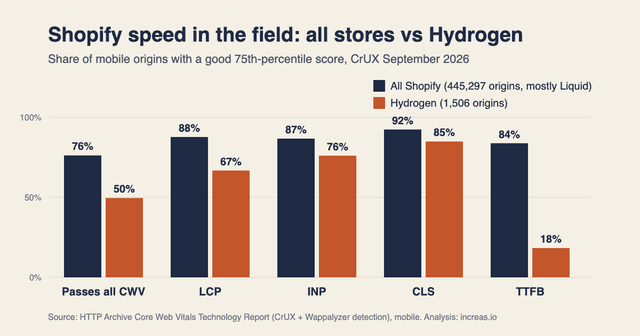
In real-user data, Hydrogen storefronts are slower than standard Shopify stores, not faster. In the September 2026 Chrome UX Report, as broken out by HTTP Archive, 76.2% of Shopify origins passed Core Web Vitals on mobile. Among the 1,506 origins detected as Hydrogen, 49.6% did. Most of the gap is server response time: 83.8% of Shopify origins have a good mobile TTFB, against 18.3% of Hydrogen origins. Going headless does not make a store fast by itself. Hydrogen pages run server code on every uncached request, and the data suggests many Hydrogen stores are not caching enough of it.
Key takeaways
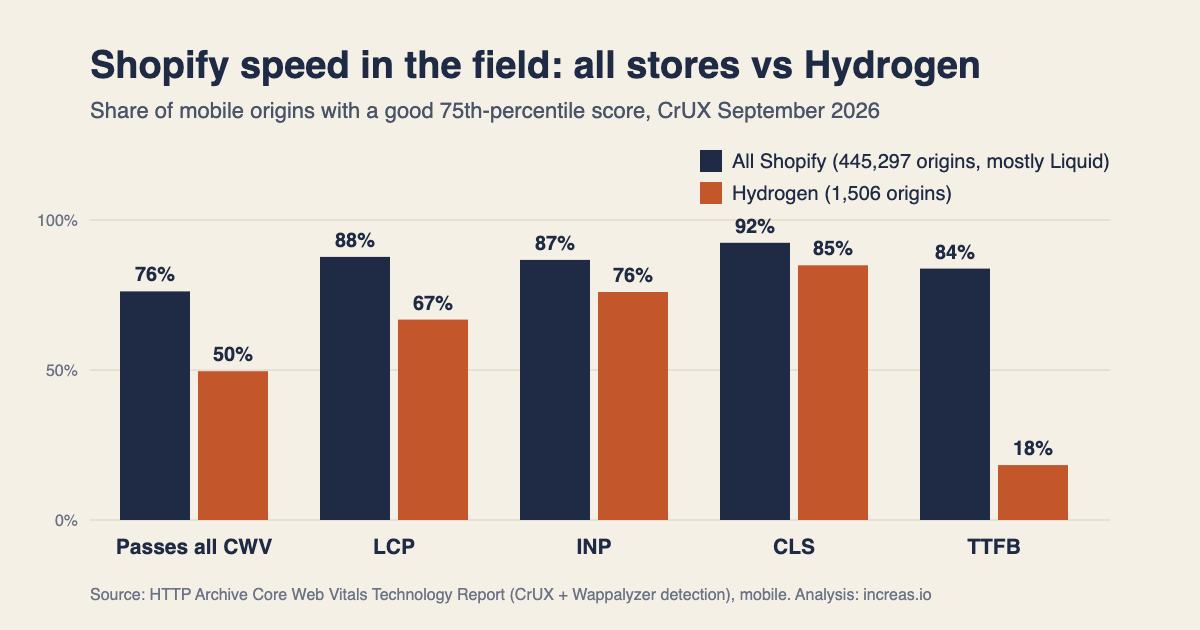
- On mobile, Hydrogen trails Shopify overall on every Core Web Vital: LCP 66.8% good vs 87.7%, INP 76.0% vs 86.7%, CLS 84.9% vs 92.4%.
- TTFB is the big gap. Fewer than 1 in 5 Hydrogen origins reach the 0.8 s "good" mark at the 75th percentile on mobile. On desktop the figure is 27.6%, against 92.6% for Shopify.
- The gap holds for larger brands. Among origins in the CrUX top 1 million, 40.1% of Hydrogen stores pass Core Web Vitals on mobile, against 63.7% of Shopify stores.
- Hydrogen is improving. The mobile pass rate rose from 32.4% in September 2024 to 49.6% in September 2026, while the number of detected origins nearly tripled.
- For Liquid stores the weak spot is different: JavaScript weight and INP. The median Shopify home page ships 2.29 MB of JavaScript on mobile, more than double the Hydrogen median of 1.06 MB.
Are Hydrogen storefronts faster than Liquid themes?
No. On field data, the average Hydrogen storefront is slower than the average Shopify store on every metric that counts. This is the September 2026 mobile snapshot from the HTTP Archive Core Web Vitals Technology Report, which we pulled from its public API on October 20, 2026. Each cell is the share of origins whose 75th-percentile value is "good".
| Mobile, September 2026 | All Shopify (445,297 origins) | Hydrogen (1,506 origins) |
|---|---|---|
| Passes Core Web Vitals | 76.2% | 49.6% |
| Good LCP (2.5 s or less) | 87.7% | 66.8% |
| Good INP (200 ms or less) | 86.7% | 76.0% |
| Good CLS (0.1 or less) | 92.4% | 84.9% |
| Good TTFB (0.8 s or less) | 83.8% | 18.3% |
| Median JavaScript, home page | 2.29 MB | 1.06 MB |
| Median Lighthouse performance score | 48 | 53 |
Two details matter for reading this. First, the "Shopify" group includes the Hydrogen stores, because the detection rule for Hydrogen implies Shopify. They are 0.3% of that group, so the Shopify column is effectively the Liquid baseline. Second, Hydrogen wins in the lab and loses in the field. Its Lighthouse median is higher and its JavaScript payload is half the size, yet real shoppers get a slower first byte and a later LCP. That points at the server, not at the browser.
Why is Hydrogen TTFB so much worse?
Our reading of the data: a Liquid page is rendered and served by Shopify's own infrastructure. A Hydrogen page is rendered by your server code, which waits on Storefront API calls before it can send HTML. If those calls are not cached, every product page view pays for them in sequence. The thresholds come from Google: web.dev calls 0.8 s or less a good TTFB at the 75th percentile, and notes that TTFB is not itself a Core Web Vital. It still feeds LCP, which is why the LCP column drops too.
The trend line supports this. Hydrogen's overall mobile pass rate climbed from 32.4% (September 2024) to 45.2% (September 2025) to 49.6% (September 2026). Its good-TTFB share moved from 12.8% to 24.6% and then back to 18.3% over the same points. Good LCP rose from 46.6% to 66.8% in that time, so the front end got better. Server response did not keep up as more stores launched.
Does the gap hold for big brands?
Yes, in the top 1 million. Hydrogen skews toward larger brands (21% of Hydrogen origins rank in the CrUX top 1M, against 11% of Shopify origins), so we filtered both groups by rank. In the top 1M, 40.1% of 319 Hydrogen origins pass on mobile, against 63.7% of 47,954 Shopify origins. Good TTFB is 19.4% against 85.7%.
In the top 100k the picture flips: Hydrogen 43.3%, Shopify 38.3%. But that Hydrogen sample is 30 origins, which is too small to base a decision on. The more useful signal from that tier is about Liquid. Only 45.9% of the 1,830 top-100k Shopify origins have good INP on mobile. The bigger the Liquid store, the more apps and scripts it carries, and interaction latency is where it shows.
What did Shopify's own Hydrogen demo show?
It was fast but not cached. On October 20, 2026 we requested Shopify's public Hydrogen demo (hydrogen.shop) and the Dawn theme demo store seven times each, from one machine in Kyiv, using curl with a mobile user agent. Median time to first byte:
| Page | Median TTFB | Range |
|---|---|---|
| hydrogen.shop, home | 331 ms | 305 to 419 ms |
| hydrogen.shop, collection | 349 ms | 307 to 496 ms |
| hydrogen.shop, product | 375 ms | 291 to 730 ms |
| Dawn demo, home | 236 ms | 212 to 271 ms |
| Dawn demo, collection | 301 ms | 216 to 575 ms |
Both are well inside 0.8 s, so this is not a broken demo. The response headers were the interesting part. Every hydrogen.shop response carried oxygen-full-page-cache: uncacheable, so each request ran the storefront worker. A demo with a tiny catalog can afford that. A store with heavy product queries, a CMS call and a reviews call on the same page usually cannot. This is a single-location, small-sample check, so treat it as an illustration of the mechanism, not a benchmark.
How do you fix TTFB on a Hydrogen 2026-10 storefront?
Cache every catalog query that is not personal. Hydrogen 2026.10.0 shipped on October 9, 2026, and it changes the model. Shopify's migration guide says that from 2026-10 Hydrogen "is a library that you add to your framework". Your app owns the server entry, the router and the build. The templates are React Router 7 on Oxygen and a Next.js 16 template on Vercel. Caching is now something you wire up yourself, and the docs are explicit that a client with a cache store but no per-query strategy caches nothing.
On Oxygen or Cloudflare Workers, pass the platform cache and waitUntil to the Storefront API client, then give each catalog query a strategy. This compiles under tsc --strict against @shopify/hydrogen@2026.10.1, the current release:
import {Cache, type CachingStrategy, gql, type StorefrontClient} from '@shopify/hydrogen';

const MENU_QUERY = gql(`
  query Menu($handle: String!) {
    menu(handle: $handle) {
      items { title url }
    }
  }
`);

const PRODUCT_QUERY = gql(`
  query Product($handle: String!) {
    product(handle: $handle) {
      title
      availableForSale
      selectedOrFirstAvailableVariant { price { amount currencyCode } }
    }
  }
`);

type Client = StorefrontClient<{cache?: CachingStrategy}>;

// Navigation changes a few times a month: serve from cache for an hour,
// then stale for up to 23 more while it refreshes in the background.
export async function loadMenu(storefront: Client) {
  const {data} = await storefront.graphql(MENU_QUERY, {
    variables: {handle: 'main-menu'},
    cache: Cache.long(),
  });
  return data?.menu ?? null;
}

// Price and availability move faster: one minute fresh, 9 seconds stale.
export async function loadProduct(storefront: Client, handle: string) {
  const {data} = await storefront.graphql(PRODUCT_QUERY, {
    variables: {handle},
    cache: Cache.short({maxAge: 60}),
  });
  return data?.product ?? null;
}
We checked the values in the 2026.10.1 package source: Cache.long() is maxAge 3600 with staleWhileRevalidate 82800, Cache.short() is 1 and 9, and overrides merge over those defaults. Rules from the caching docs are worth repeating to your team. Pass the cache from caches.open() directly, not wrapped in an adapter or swapped for an in-process LRU. Never put a strategy on the cart or anything tied to a customer session. On Next.js, skip Hydrogen's strategies and use the framework's "use cache" with cacheLife() and cacheTag(), which needs cacheComponents: true.
Two more things we look at on every slow Hydrogen store:
- Sequential awaits. A loader that awaits the product, then the CMS block, then recommendations pays three round trips. Run independent queries in parallel and stream the slow, non-critical ones.
- Full-page cache on older versions. Oxygen's full-page cache, driven by a public
Oxygen-Cache-Controlheader plus aVaryheader, is documented for Hydrogen 2026-04 and earlier. AnySet-Cookieheader makes the response uncacheable. The 2026-10 docs we read today do not describe it, so confirm with Shopify before you plan around it on the new version.
How do you speed up a Liquid Shopify store?
Cut JavaScript first. Liquid stores already win on TTFB, so their problem is what runs in the browser. The median Shopify home page ships 2.29 MB of JavaScript on mobile, up from 1.91 MB a year earlier, and good INP slipped from 89.7% to 86.7% of origins over the same year. Shopify's theme performance guide gives no byte budget. Its advice is to audit every app and pixel, remove render-blocking app scripts, defer the rest, and never lazy-load the LCP image. In practice that is an app audit, not a rebuild. Going headless to fix an INP problem caused by twelve apps moves the apps to a new codebase and adds a server you now have to tune.
How did we pull this data, and what are its limits?
The numbers come from the HTTP Archive report API, which joins CrUX field data with technology detection on each site's home page. The report's methodology post explains that an origin passes when 75% of experiences are good on each metric, and that a whole origin's data is credited to whatever technology was detected on its home page. Limits we know of:
- Detection. Hydrogen is detected by a
powered-byheader matchingShopify.+Hydrogenin HTTP Archive's Wappalyzer rules. Stores that strip the header are missed. Detected origins jumped from 38 in March 2024 to 537 in September 2024, which looks like a detection change, so we start the trend there. Hydrogen 2026.10.1 setspowered-by: Shopify, HydrogenfromapplyResponseHeaders(), so Next.js storefronts on Vercel that follow the docs should start appearing in later months too. - Origin level. CrUX scores the whole origin. A store with a fast home page and slow product pages is scored on the mix.
- Correlation. These are groups of stores, not before-and-after migrations. Hydrogen stores may differ from Liquid stores in catalog size, markets or traffic mix.
What does it cost to fix a slow storefront?
It depends on which problem you have. For a Hydrogen store with poor TTFB, the work is mostly caching and loader structure, and we scope it per project after reading the data loaders. For a Liquid store with poor INP, it is an app and script audit. If headless is the right call after all, our custom Hydrogen builds take 3 to 7 weeks and start from $3,400, and our hosting cost calculator covers the running costs. For the build-versus-stay decision itself, read is Shopify Hydrogen worth it. If your storefront runs on Next.js, the Shopify webhook revalidation snippet in Next.js vs Gatsby for ecommerce pairs with cacheTag(). Data date for everything above: CrUX September 2026, pulled October 20, 2026; package checks against @shopify/hydrogen@2026.10.1.
Do you want secure, fast website or application?